
Mobility is your ability to actively control movement through a useful range of motion. Flexibility is the amount of range available at a joint or series of joints, often when an external force such as gravity, your bodyweight, a partner or a stretch helps you get there. In simple terms, flexibility is how far you can move; mobility is how well you can control that movement yourself.
My excessively bendy friends will probably disagree, but for most people, being flexible enough to move well, train hard and do the things they want to do is plenty. More is not automatically better.
A challenge for you
Stand with your feet together, with your toes and heels firmly flat on the floor, and sit down into a squat as low as you comfortably can without falling over. Spend a little time down there and then stand up. If that is too hard, place your feet a little wider apart.
I like this as a simple movement check, but not everyone should expect to look exactly the same in a deep squat. Limb proportions, hip anatomy, ankle range and training history all affect how the movement looks. The point is simply to notice what your body can currently do and where you feel restricted.
I see mobility training as being more about maintaining or regaining useful movement than doing high-level gymnastics drills. But guess what — and I can talk from experience, having taken up gymnastics myself — when you add sensible mobility work to your weekly training, you often start moving more freely, feeling less restricted and suddenly find that all sorts of interesting movements, body positions and party tricks become available to you.
Aside from the hips and ankles, pay attention to the mobility of the spine and shoulders too, particularly as part of your general warm-up and training.
Mobility Educators
I’m a big fan of Gray Cook’s joint-by-joint approach, which is a useful way of thinking about how different areas of the body tend to prioritise either mobility or stability.
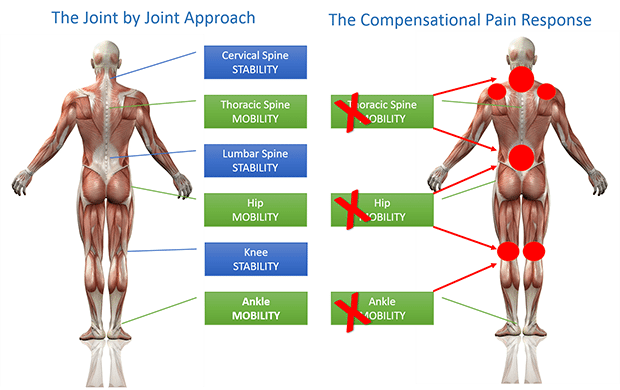
All of Grey Cook’s work is solid, and his book: Athletic Body In Balance is worth studying. However, my go-to educator in this field would Dr Kelly Starrett. I’ve done some of his courses, and he’s phenomenal. His book ‘Becoming a Supple Leopard’ is by far the best book I’ve read on mobility, and I can’t recommend it enough.
The limits of this course
There are many books, academic papers, qualifications and experts who have dedicated their entire careers to mere elements of each one of the athletic pillars, so obviously, all I offer on this course is a little taste. If you are into fitness and training, please at least please check out some free youtube lectures from Gray Cook or Kelly Starrett… this will probably lead you down a rabbit hole of the mobility and movement training subculture. You’ll end up watching hours of videos with Erwan Le Corre and Ido Portal, and many other impressive humans showing you what the body can do when you are focused a bit more on mobility training.
My Mobility Prescription
Dramatic improvements in mobility take time… so you may as well start now! The least you should do is 5 minutes of mobility work per day as the main component of your warm-up routine. Once that is a habit, then doing separate days of pure mobility work or adding mobility into the strength and/or skills pillar is a good idea. For example, doing a full-range close grip supinated (palms in) Pull Up develops strength in the biceps and shoulder and improves shoulder mobility. Another good example is the Muay Thai Slashing Elbow strike (filmed 2022 when i wrote this course). Doing this will improve your combat skills AND both your shoulder & spinal mobility. Let me show you what I mean…
Flexibility
While in my professional opinion, mobility is far more important than flexibility, that doesn’t mean you should never stretch! Static stretching, Hatha Yoga and PNF stretching can all be very effective ways of improving flexibility and reducing feelings of tightness.
If you love stretching and feel flexibility is vital, you probably won’t like how short this section is! The simple truth is that you don’t need to be super flexible for athletic performance or general health. You need enough flexibility for the movements and activities you want to do, and more is not automatically better.
If you stretch consistently and sensibly, you can improve flexibility surprisingly quickly. With static stretching, holding a meaningful stretch for around 30–60 seconds is often plenty, and there is no need to make every stretch horribly painful.
And if you want to do the splits, then in my experience — and this is purely anecdotal — pretty much any young woman can get there within six months, and most men within a year, if they are prepared to put in the work and spend serious time stretching the hamstrings, glutes, hips and surrounding areas. Anatomy, training history and age obviously play a part, but that has been my experience.