


Five Secrets to a Supermodel Body
A Lean, Fit and Healthy Physique
Spend any time in gyms or follow female fitness creators on social media, and it’s clear that many women in 2026 aspire to a strong physique.
Body trends come and go. What matters is what you want from your body.
This report is for women who don’t aspire to the new ‘gym-body’ norm. It’s for women who prefer a leaner, more understated look: toned, fit, athletic and feminine, without appearing as though they go to a gym, let alone live in one. Think of the naturally lean, elegant physiques associated with the supermodels of the mid-to-late 1990s.
You won’t find many scientific studies — or an accurate AI prompt — explaining precisely how to create a ‘supermodel body’. Much of what follows, therefore, draws on my own coaching experience: more than two decades working with fashion models, from helping new models prepare for the demands of the industry to coaching established supermodels and Victoria’s Secret Angels to look, move and feel their best.

How to Use This Report
As you read, you’ll discover the philosophy behind my work and five key lessons to help you develop a leaner, fitter and more elegant physique.
There’s a lot of information here, so don’t feel you need to change everything at once. Read the full report first, then take a few minutes to reflect and choose the three ideas that resonate most with you. Commit to putting them into practice within the next 24 hours.
Follow them consistently for two weeks. Then return to the report, choose two more ideas and introduce those too.
You get the idea.
Knowledge is useful. But it’s only through applying what you learn that change happens.
Lesson 1 | Blame Your Parents
Let’s start with the obvious. Can everyone (without extensive surgery) get the body of a supermodel? Well… no. Of course not. Nor is that necessarily a bad thing. Global fashion standards still haven’t caught up with the diverse world we live in and, deep down, largely promote an ‘ideal’ of a fashion model being young, tall and slim.
There’s plenty we could say about that. But in the context of this article, I simply want you to be careful with your aesthetic goals. Make sure your ideal body really is YOUR ideal body — not society’s, an algorithm’s, a magazine editor’s or some random luxury brand’s marketing department.
Changing your body takes time and energy, so think about the process as well as the result. Does getting there sound enjoyable, empowering or worthwhile? Great. If achieving your ‘ideal’ body is likely to damage your relationships, career, health or happiness, perhaps it’s the goal that needs changing.
There’s little point putting all your energy into climbing a ladder only to reach the top and realise you’ve leaned it against the wrong building. (I’m not entirely sure that analogy works… but you get my point.) I’ve worked with countless objectively beautiful women over the years — actresses, pop stars and fashion models — and I’ve seen first-hand that looking a certain way has surprisingly little to do with happiness, self-esteem or body confidence.
However, the process of training towards an aesthetic goal — even a predominantly vain one — can be enormously positive when approached intelligently. If pursuing the body you want means developing healthier habits, greater awareness, discipline, commitment and physical capability — and, importantly, you actually enjoy the process — well… that sounds pretty good to me.
Case Study | Turning a Non-Model into a Victoria’s Secret Angel
Genetics undeniably play a significant role in how you look, but you can still dramatically change your physique through intelligent training, nutrition and lifestyle choices. Let me give you an example.
About ten years ago, the Daily Mail asked me to ‘transform’ one of their journalists into a Victoria’s Secret Angel. Feeling pretty confident in my skills, I agreed. It took us four months. She worked damn hard, although, to be fair, Poppy was already lean and active when we started. Had she been a UK size 14 and never exercised before, the same transformation would have required considerably more time.
I mention this because transformations can be inspiring, but context matters. Your starting point, genetics, lifestyle and the amount of time and energy you’re prepared to invest will all influence what’s realistically achievable. The principle, however, is simple: be clear about the outcome you want and understand what achieving it will require. Training properly when no one is watching, cooking when ordering a takeaway would be easier, getting enough sleep, and completing that final rep you’d rather avoid — these are all choices within our control. Repeated consistently, they can dramatically change how we look, move and feel.
I’m proud of what Poppy achieved, and I later wrote the foreword to her book, Poppy’s Secret. But there’s another lesson here. Magazines and social media love asking celebrities, models and fitness creators for the ‘secrets’ behind their bodies. Personally, I’d pay considerably more attention to the principles of exercise and nutrition.
People can have impressive bodies despite their training, not necessarily because of it.
That’s an important distinction. Don’t blindly copy someone else’s workout because you admire their body. What they believe works for them may be interesting, but it isn’t necessarily applicable — or optimal — for you. My advice? Learn to ask why. Why this exercise? Why this number of repetitions? Why this diet? Why this amount of cardio? Don’t take advice blindly, including mine. Understand the reasoning, pay attention to how your own body responds, take what’s useful — and discard the rest.

Lesson 2 | Train Intelligently
Is Weight Training Important for a Lean, Supermodel Body?
The first thing to know is that the young women I work with who need to get into shape quickly for Fashion Week, a campaign shoot, movie role or upcoming casting ALL lift heavy-ass weights.
Weight training is one of the fastest ways to change your physique, and being strong is an important foundation for an athletic, capable and well-functioning body.
There is, however, a caveat.
The traditional ‘fashion model look’ is quite specific and increasingly different from the physique celebrated by mainstream fitness culture. Over the past decade, women’s fitness has embraced strength and muscularity — which is great if that’s the look you want.
But fashion models, aspiring models and women who prefer a softer, leaner and more understated physique usually don’t want significant muscular development through the arms, glutes, thighs, upper back or shoulders.
That doesn’t mean avoiding weights. It means being selective about where and how you lift heavy.
I use a wide variety of resistance-training exercises with my model clients. There are around 20 movements I return to frequently, alongside several popular gym exercises I rarely prescribe when the goal is a traditional fashion-model aesthetic or when preparing someone for a specific shoot, campaign or event.
Below are a few examples.
3 Important Weight-Lifting Moves for Models
1. Romanian Deadlifts (RDLs)
RDLs are one of my favourite exercises for developing the hamstrings and glutes while building serious posterior-chain strength, without placing the same emphasis on the quads as squats and many other popular lower-body exercises. This matters in fashion. Models’ hip measurements are typically taken below the hip bone, so adding significant muscular size through the thighs and glutes can make fitting into sample sizes more difficult. For runway models in particular, that matters.
This doesn’t mean they shouldn’t get strong.
Some of my catwalk clients can RDL around 1.75× their bodyweight for several repetitions, without me worrying that they’re suddenly going to develop huge legs. I also programme plenty of unilateral (single-leg) RDLs. They help address left-to-right imbalances and develop balance, coordination and stability, while allowing us to train the hamstrings and glutes with considerably less absolute load.
When lower-back strength needs more specific attention, I may rotate deficit deadlifts and other deadlift variations into the programme. As I write this, several of my runway clients can lift more than 100kg. Summer 2026 update: my long-term client Fran Summers lifted 112.5kg with me last week — literally the week before a Vogue cover shoot. She’s a beast! And a pretty good example of why lifting heavy doesn’t automatically mean looking bulky.
Hip thrusts are also an excellent exercise and allow us to place even more emphasis on the glutes, so I use them regularly. But I like exposing my female clients to elements of powerlifting and developing genuine physical capability, so RDLs and their variations remain a staple.
2. Unilateral Bent-Over Rows
Unilateral rows train the back, arms and shoulders, while also demanding stability and coordination through the trunk. There are several ways to perform them, and, as with almost every exercise, it’s not just what you do; it’s how you do it that matters.
One variation I particularly like uses a little more speed and controlled torso rotation, allowing greater movement through the lats and making the exercise feel more athletic. It’s not the variation I’d choose if my primary objective were strict postural work or maximal lower-trapezius and rhomboid activation. But when appropriately coached, I like the combination of strength, movement and athleticism it provides. It’s also more fun.
Many of the experienced models I coach work with around 17.5kg for this variation, although the appropriate weight and repetitions obviously depend on the individual.
3. Posterior Deltoid Flyes
Posterior deltoid flyes are a simple but very useful accessory exercise for developing the rear shoulders and upper back.
For the particular aesthetic we’re discussing here, I often favour them over lots of lateral-raise volume or excessive overhead pressing, because they allow us to develop definition through the shoulders and upper back without deliberately chasing additional width through the lateral deltoids. They’re also one of those exercises that look considerably easier than they are.
For many clients, 3–4kg in each hand is plenty when they’re performed properly. I generally use higher repetitions — often 3–4 sets of 12–15 — with an emphasis on control and execution.
Five Good Exercises I Never Use with Models
- Weighted Squats – as there is far too much emphasis on quads.
- Wide-grip Lat Pull-Downs – as it builds up the upper back and shoulders too much.
- Shrugs – as it builds up the neck too much.
- Triceps push-downs – make arms look too big
- Leg Extension & Presses – too much emphasis on the front of the legs (quads)
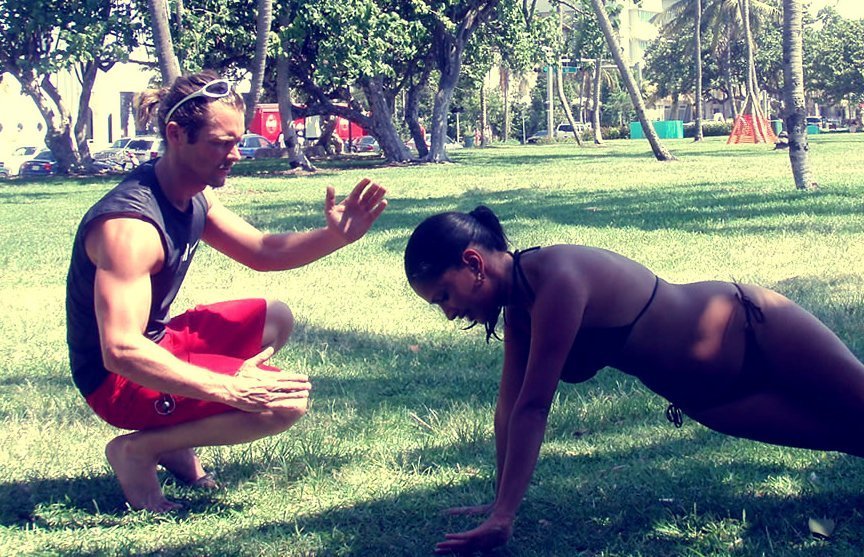
The Best Cardio for a Supermodel Body
Weight training is brilliant for building and maintaining muscle while changing the shape and composition of your body. So where does that leave cardio?
Well, cardio matters too.
It helps increase energy expenditure, improves cardiovascular fitness and VO₂ max, supports the health of your heart and lungs, and — perhaps most importantly — helps you actually feel fit.
Regardless of how you look, it’s difficult to feel genuinely fit without doing some cardio.
Thankfully, we’re not training for a bodybuilding stage or an ultra-endurance event. If we’re intelligent about how we train, we don’t have to choose between BEING fit and healthy and LOOKING fit and healthy.
For the lean, athletic physique we’re discussing here, I want both.
My Top Six Cardio Machines
- VersaClimber
- Road Running or Curved Treadmill
- Cross Trainer
- Assault Bike
- Kickboxing on a punch bag
- Jacob’s Ladder
And What About Battle Ropes?
Battle ropes are enormously popular with fashion models on social media. But are they actually any good? In my opinion, they’re okay. Not great. Not rubbish. Just okay. Add some lower-body movement — lunges, for example — and they can become considerably more metabolically demanding. My main issue is that, with many battle-rope drills, your grip, forearms and shoulders become the limiting factor before your cardiovascular system does.
That doesn’t make them useless. Far from it. They’re particularly useful when developing grip, arm and shoulder endurance and local muscular fatigue tolerance. If you’re a wrestler, swimmer or waterskier, for example, I’d probably move them considerably higher up the list. But for most people? Use them occasionally. Have some fun with them. But that’s why they don’t even make my top twenty cardio tools, let alone my top six.
Cardio Programming
With cardio, I generally mix interval training with LSD (long, slow distance) work, often at roughly a 50/50 ratio.
When I programme both in the same session, I usually put the harder interval work first, while you’re fresh and able to perform it properly, then finish with lower-intensity steady-state cardio. Physiologically, it makes sense, and mentally, I think it feels much nicer too.
When the goal is the traditional fashion-model aesthetic — whether I’m working with professional models or clients who simply prefer that look — I’m also selective about the type of cardio we do. I generally avoid excessive uphill running, heavily resisted cycling and large volumes of rowing, as these can place considerably more muscular demand on the quads and legs than I want for this particular goal.
Again, the exercises aren’t the problem. It’s about matching the training to the outcome you actually want.
The Science Behind How I Train Supermodels
For any fellow exercise-science nerds reading this, my programming blends a range of conditioning methods, including HIIT, submaximal interval training, Fartlek and Tabata protocols. I typically prescribe two to three higher-intensity conditioning sessions per week, alongside a longer Zone 2 session to build and maintain an aerobic base.
When integrating strength and conditioning, I generally use full-body training for beginners before progressing more experienced clients to two- or three-day training splits.
My longer-term programming follows an undulating periodisation model, allowing intensity and volume to fluctuate throughout the year. Unlike bodybuilding, where the goal may be to peak for a single competition or photoshoot, my model clients need to look good, feel good and perform well all year round.
To achieve this, I’ve developed my own variation of the conjugate system, allowing multiple physical qualities to be trained simultaneously while keeping the training varied, effective and sustainable.
Before specialising in fashion models and actors, I spent years coaching professional athletes, so exercise science remains the foundation of everything I do. That said, I also draw extensively on bodybuilding for physique development, combining it with striking drills from combat sports, kettlebell training, light sandbag work, SAQ training and carefully selected elements of Pilates, yoga and the Alexander Technique.
The objective is quite specific. I want my fashion-model clients to look lean, healthy, toned and almost ‘effortlessly fit’ — without looking as though they spend their lives in the gym. But underneath that understated aesthetic, I still want them to be genuinely strong, fit, coordinated and capable.
Fitness Standards
A selection of the standards I ask my model clients to work towards.
- RDL: 1.75× bodyweight for one repetition
- 12kg kettlebell swings — 100 with no rest and good form
- 2 perfect pull-ups
- 10 proper press-ups in a row
- 90+ metres in 20 seconds on a Concept2 rower
- 10K run in under 55 minutes
I also have standards regarding box jumps, kickboxing, agility/reaction training, mobility, and posture. I always want my clients to be more athletic and capable, but when the goal is to look like a supermodel, then I don’t want them to get too muscular; that’s why aiming for 2× bodyweight deadlifts (which is one of the standards I hold my male clients to) doesn’t make sense. Nor do I hold my female clients to account when it comes to things like back squats, bench press, bicep curls, shrugs, or sprinting – as getting significantly better at any of these activities is usually not conducive to their aesthetic goals.
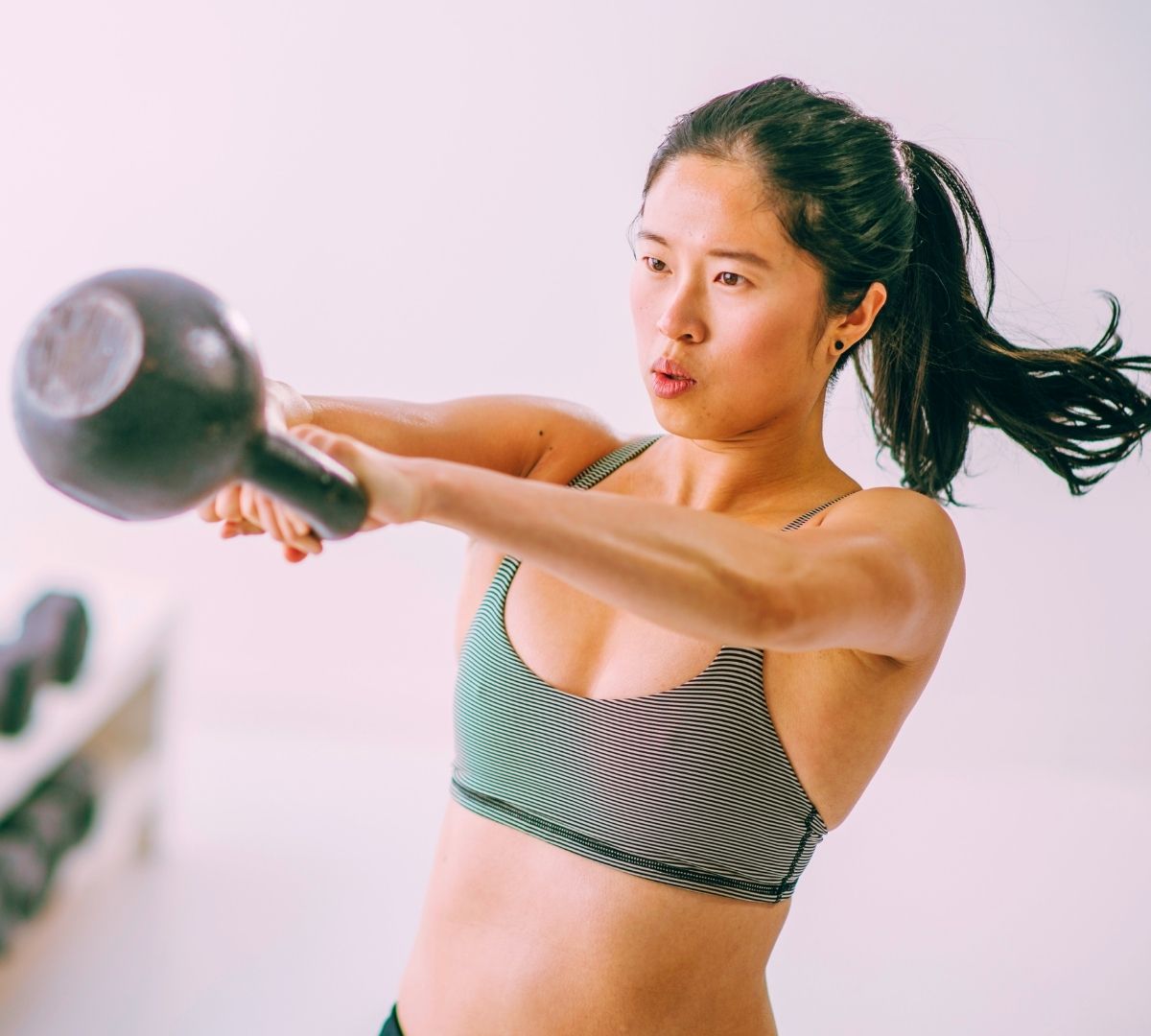
Any exercise or movement is ‘good’ for you in the general sense and is far better for the soul, brain and body than not moving. But if you want to achieve a long, lean, model-esque body I have four principles you should adhere to:
Principle One — Prioritise the Posterior Chain
Choose exercises that develop your posterior chain — the muscles running along the back of your body, particularly the hamstrings, glutes and spinal erectors.
I generally favour compound movements such as RDLs and their variations, which train these muscles to work together rather than simply isolating them. A strong posterior chain supports athletic movement, running and overall physical capability, while helping develop the shape and definition we’re looking for through the backs of the legs and glutes.
Principle Two — Challenge Your Core
Choose exercises that require your core to work rather than simply adding endless ‘ab exercises’. Developing strength and control through the trunk creates a foundation for more advanced training, improves movement quality and helps you transfer force efficiently throughout the body.
Principle Three — Develop Body Awareness & Athleticism
Choose exercises that improve coordination, balance, movement skill and your awareness of your own body. When we train mindfully and athletically, we begin to treat the body more like an instrument than an ornament. Yes, you may want to look like a model. But I also want you to feel athletic, capable and confident in what your body can actually do.
Principle Four — Train for Better Posture
Choose exercises that help you develop the strength, mobility and body awareness required for good posture.
Good posture can immediately change how you present yourself — creating a taller, more composed and confident appearance — but its value goes beyond aesthetics. Moving well and having the capacity to comfortably adopt different positions matters for both performance and everyday life.
Lesson 3 | Choose Your Online Workouts Wisely
There are so many, and they can be a lot of fun! Well-known workouts such as Zumba™, Kayla’s BBG™, MX™, Pvolve™, Barrecore™, Bodycombat™, Insanity™ and P90X™ – all can have benefits for women, but what’s best for you? There are many new workouts dedicated to female well-being launching every year, as well as more generic classes that focus on boxing, Pilates, ballet or yoga – so how do you know if they are any good for you and your body goals?
Give everything a try as you don’t know what you like until you try it! But the number one rule is to do your research.
Trial and error is one way of finding out. But if your time is precious, I recommend looking into the philosophy and credentials of whoever created the programme, understanding what it’s actually designed to achieve, and seeking out genuine feedback from people who’ve followed it.
For the particular aesthetic we’re discussing here, I’m selective about activities that place a lot of repeated loading through the thighs. I rarely prescribe large volumes of heavily resisted cycling, hill sprinting or rowing when I’m deliberately trying to minimise additional development through the quads.
That’s not because there’s anything wrong with these activities. I personally love cycling and running hills, have a rowing machine at home, and don’t have enormous quads! Context matters. Your training should reflect your body, your goals and how you personally respond to different types of exercise.
If you’re trying to create a very specific physique, don’t simply ask whether a workout is ‘good’. Ask a better question: Is it good for my goal?
MX™ Model Workout Club is my signature online training system, created to help women develop a long, lean, supermodel physique without sacrificing strength, fitness or athleticism.
Women’s Health described MX™ as “the workout bible for models.”
Lesson 4 | Eat, Sleep, Be Kind, Repeat
The next section is about eating. They say that 80% of results are diet-driven. This isn’t 100% true for people who are already slim or already eat pretty well, but there are definite things you can eat (and avoid eating) which will improve your health, mood and results.
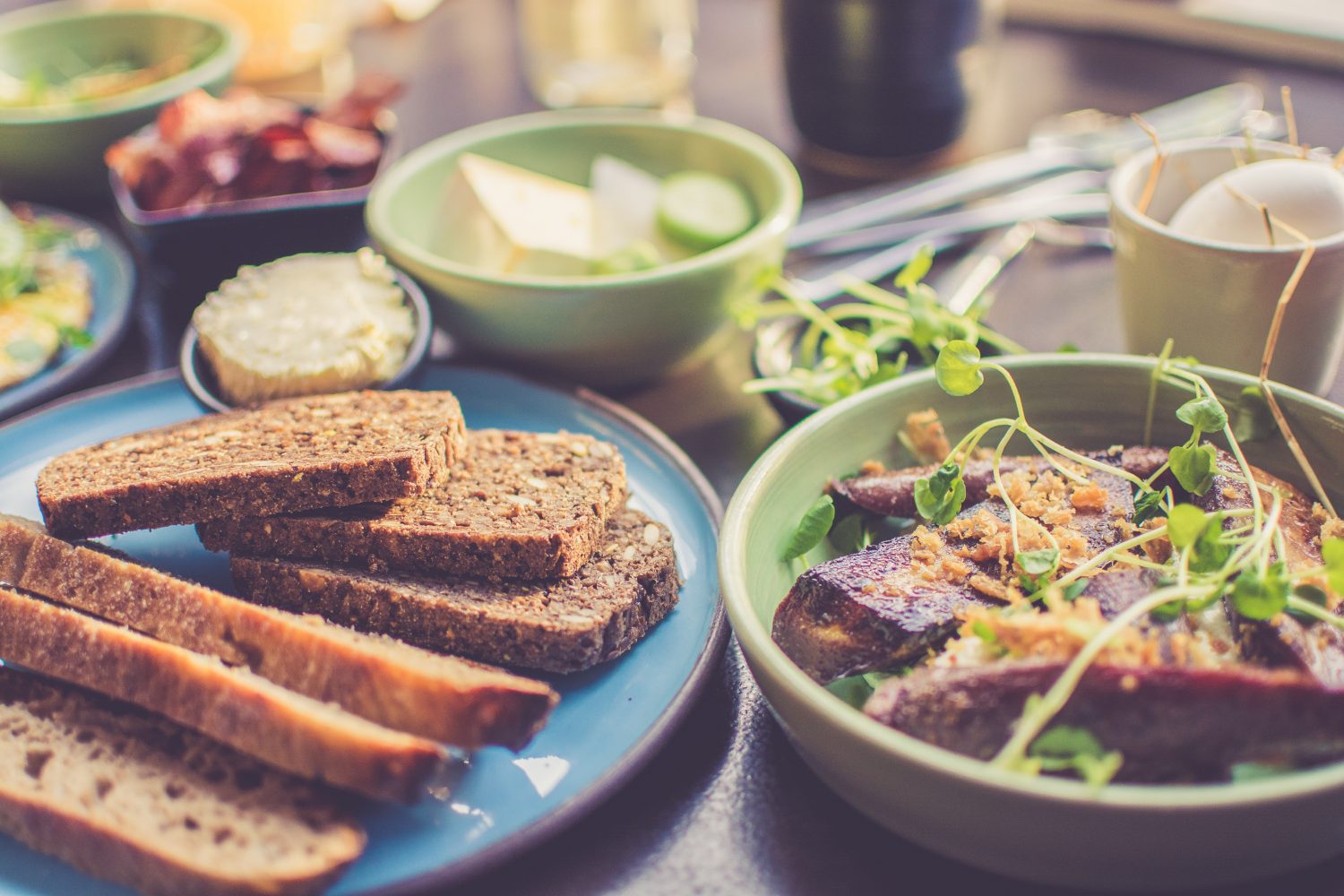
Here we’ll look at three areas of personal wellbeing that can help you achieve — and, importantly, sustain — a Supermodel Body.
Feed Yourself
Nutrition is a huge subject. There’s an enormous amount of excellent, evidence-based information available, alongside plenty of pseudoscience, questionable advice and unnecessary complexity. I’m going to keep things simple.
These are the principles I’ve found most useful when helping female clients get lean, fit and ready for everything from bikini shoots to the catwalk.
My 10 Simple Nutrition Principles
1. Eat proper meals.
Sit down two or three times a day and eat a varied, nutrient-dense, colourful meal. Look after your gut too: eating plenty of different plants, vegetables, fruit, legumes, nuts and seeds is a very good place to start.
2. Don’t make mindless snacking a habit.
There’s nothing inherently wrong with snacking, but don’t assume something is healthy because the packaging says ‘natural’, ‘protein’, ‘organic’ or ‘gluten-free’. Gluten-free is important if you have coeliac disease or a genuine sensitivity; otherwise, it isn’t automatically healthier.
3. Learn to recognise hunger and fullness.
You don’t need to spend your life either starving or stuffed. Eat slowly enough to notice when you’re comfortably satisfied and learn how your own appetite responds to different foods, training and routines.
4. Drink more water and less wine.
Simple. And for most people, rather effective.
5. Aim for consistency, not perfection.
Create a routine that works most of the time. My rough rule for models and actresses is 85/15: make choices that support your goals most of the time, and don’t judge yourself for being human the rest of the time.
6. Don’t unnecessarily eliminate entire food groups.
Unless you have a medical reason or genuine intolerance, there’s usually no need. Pasta isn’t evil. Dairy isn’t evil. Carbohydrates aren’t evil. Your overall diet matters considerably more than demonising individual foods.
7. Eat more plants.
Vegetables, fruit, beans, legumes, nuts, seeds, herbs — variety matters. Rather than obsessing about one ‘superfood’, aim to eat a broad range (i.e., 30+) of plants across the week.
8. Learn to cook.
It’s one of the most useful health skills you can develop. Cooking gives you greater control over what you eat and, more importantly, can create a much healthier and more enjoyable relationship with food.
9. Base most of your diet around minimally processed foods
Ultra-processed foods can make it very easy to consume lots of calories without feeling particularly satisfied, so I generally encourage clients to build most meals around recognisable whole or minimally processed ingredients.
But don’t start fearing ingredient lists or E-numbers. ‘Processed’ doesn’t automatically mean unhealthy, just as ‘natural’ doesn’t automatically mean good for you.
10. Don’t try to ‘hack’ bloating.
Bloating is normal and can fluctuate with food intake, hydration, digestion and the menstrual cycle. Staying appropriately hydrated, eating regularly, moving, sleeping well and understanding which foods personally affect you are more sensible strategies than trying to dehydrate yourself before an event. Having said that… dramatically reducing salt intake 48 hours before an event is one hack I’d recommend!
And this is one area where I’ll be unequivocal: don’t use diuretics, laxatives, ‘detox’ teas or fat-burning pills to look leaner. The temporary visual change isn’t worth the potential consequences.
If you have persistent or painful bloating, that’s something to discuss with an appropriately qualified healthcare professional rather than trying to fix through increasingly restrictive dieting.
Sleep Well
We all need different amounts of sleep at night, and actually, quality is more important than quantity. To improve your quality of sleep, my advice is go to sleep happy!
This means avoiding stressful situations, arguments and all those boring yet stimulating activities like reading work emails on your phone or mindlessly scrolling through strangers’ filtered lives on TikTok. Experiment with different tactics – when you are training hard, I advise sleeping an extra 30 minutes a night, but do whatever feels normal and right for you.
Listen to Episode 12 of the MX podcast, where I chat with J.Lo’s trainer, Jay Cardiello, all about sleep and mindset.
P.S. My recommended products page on this website includes a weighted sleep blanket. If you want to sleep better, it really is a game-changer!

Be Kind
Self-improvement can become self-indulgent if we’re not careful. We can become so committed to exercising, eating well, removing ‘toxic’ people and generally living our best lives that we end up becoming self-obsessed — and increasingly judgmental about how everyone else chooses to live.
We’re all at different stages of our own journey through health, wellbeing and general adulthood-ness. Try not to judge. Be kind. Support other people. Celebrate their progress as well as your own.
No matter how ‘hot’ your body becomes, narcissism is ugly.
And on the flip side, genuine kindness — without expecting anything in return — might just be the most attractive quality any person can possess.
Lesson 5 | It’s All in the Mind

The Supermodel Mindset
In this final part, I want to share what I believe separates people who make — and sustain — remarkable changes from those who don’t.
Mindset.
My company has had the tagline Live the Athletic Life since 2013. To me, having an athletic mindset means appreciating the body you have today while still being curious about what it could become tomorrow.
The older I get, the more I’ve come to believe that happiness and gratitude are closely connected. Ambition and self-acceptance don’t have to be opposites. You can appreciate your body now while still wanting to make it stronger, fitter, healthier or, yes, better-looking.
An athletic mindset also means appreciating and using your body as a vehicle for self-expression — an instrument, not simply an ornament. That’s a far healthier and more rewarding relationship with your body than reducing your value to how good you look in clothes.
Focus on Performance, Not Just Aesthetic Results
There should always be easier days and harder days in a well-designed training programme. But in my experience, most people are capable of working considerably harder than they think — and are missing out on how good that can feel.
So this week, challenge yourself.
Run a little faster. Lift a little heavier. Improve your technique. Do another good rep when you’d normally stop. Don’t worry about what the person next to you is doing; aim to outperform the person you were last week.
And occasionally, when the exercise and programme call for it, discover what you’re genuinely capable of. Don’t spend the session taking gym selfies or checking whether you look ‘toned’ yet. Be present. Concentrate. Train with intent. Aim for excellent technique and give every repetition your attention.
Make performance the game and let the aesthetic changes become a consequence of playing it well. You’ll get more from your training — and, in my experience, it’s considerably more rewarding and much more fun.
I always remind my clients that they are athletes. They live active, healthy lives and will often be kickboxing, ‘MX-ing’, lifting heavy weights, learning new skills and generally working their butts off!
You may not feel like it right now, but YOU are also an athlete. No matter your age, size, shape or current fitness level, you are designed to move and improve. Please celebrate this fact as you train for your goals.
A Gift for You
If you want help with your mindset, I have something for you: It’s 90 consecutive daily mindset lessons, delivered straight to your inbox. sign up here to receive them. It’s totally free.

Where Next?
Hopefully, this feature has given you some things to think about, and you’ll incorporate some of the exercise, nutrition and mindset ideas into your training. If you want more assistance, you have some options:
- Apply for Private Training – available via Zoom
- Sign up for my MX Fashion Model Workout Club.
- Enjoy our complimentary tools, courses & resources via The Library
- Work out now! – try Glide Away for a 60-minute blast
- (NEW) Read more tips, hacks and ideas on fitness and well-being @ The Journal